


Osteochondrosis of the lumbosacral spine is more popularly known as “sciatica”, “low back lumbago”, a disease that affects both men and women in equal percentages.Osteochondrosis in the lumbar and sacral region is in first place among the causes of disability or temporary incapacity for a person.The disease is based on the destruction of the vertebrae and their deformation, damage to the intervertebral disc, changes in the ligamentous apparatus, pinching and inflammation of nerves and blood vessels.
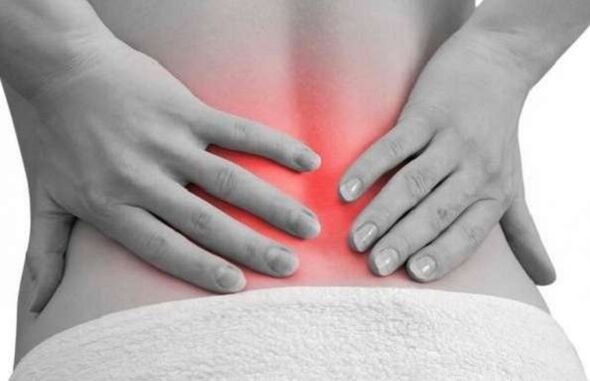
Pain in the lumbar and sacral area is in first place among the causes of temporary or complete disability of a person.
As a rule, lumbar osteochondrosis has a chronic course with periods of exacerbations and remissions.Causes of exacerbations: hypothermia, lifting and carrying (in front of) heavy objects, stress and back injuries.
Etiology and mechanism of development
The exact reason why osteochondrosis develops in the lumbar region has not been fully found.It is believed that osteochondrosis in this area of the spine is of a multifactorial nature.More plausible reasons could be:
- Constant loads.
- Overstrain of the lumbosacral region.
- Muscular hypotonia.
The basis of all the reasons is upright posture; it is the constant presence in an upright position that puts pressure and overload on the vertebral segments on the lower back and sacrum.No part of the spinal column experiences such pressure on the intervertebral discs, bones and ligaments.Adding to this the extreme mobility of the lower back, constant bending and turning, it turns out that the muscles, bones, ligaments and cartilage in this department experience enormous stress throughout life.And like any “living mechanism,” the spine tends to fail sooner or later.
Reasons contributing to the development of osteochondrosis:
- Metabolic and endocrine disorders.
- Microtraumas.
- Autoimmune changes.
- Genetic factor.
- Visceral causes (pathologies of internal organs).
- Abnormal development of the spinal column.
Recent studies have proven that a larger percentage (60%) of all reasons for the development of osteochondrosis of the lumbar spine is due to heredity.The remaining 40% is due to related reasons:
- Incorrect posture.
- Carrying heavy things.
- Hormonal changes in the body.
- Somatic and endocrine diseases.
- Poor blood supply to the spine.
- Age, stress.
- Poor unbalanced diet.
All of these factors, taken together or individually, are the causes that contribute to the degeneration of intervertebral discs in the lumbar region.The logical conclusion of the destructive process that once began is lumbar osteochondrosis.
Most often, the development of osteochondrosis in the lumbosacral spine is observed in people whose work involves a sedentary lifestyle (office workers, drivers).It is physical inactivity that leads to a weakening of the muscular corset of the back, which means that the supporting force disappears, which weakens the load on the intervertebral discs and bone skeleton.Those second in the risk group are those whose work involves heavy stress on the back.And it’s not necessarily heavy lifting: staying in one standing position for a long time (surgeon) or walking without the opportunity to sit down (waiter, salesperson) does not allow the spine to rest.

The development of osteochondrosis in the lumbosacral spine is often observed in people with sedentary work.
Stages and clinical signs of pathology
Like any disease, osteochondrosis of the lumbar spine has a beginning, middle and final stage, and each of them has its own symptoms.There are three degrees of the disease, different in terms of signs and complications of the pathological process, and each degree is characterized by its own diagnostic measures and treatment.
Degrees of the pathological process:
Osteochondrosis 1st degree
The mildest, initial stage of the disease.As a rule, a person does not pay attention to the symptoms of developing osteochondrosis.Ignored: minor pain and discomfort in the lumbar and sacral regions, which occurs when bending, turning or sitting in one place for a long time.Stage 1 does not require special treatment; it is enough to eliminate the cause of the symptoms and undergo a course of exercise therapy and massage.In some cases, external preparations (gels, creams) or weak analgesics are used.Serious drug treatment (tablets, injections) is not required; therapeutic exercises are indicated to improve the elasticity of ligaments and muscles.
But as much as the symptoms of stage 1 are insignificant, this stage is fraught with insidiousness: ignoring pain and self-medication leads to complications and progression.
Osteochondrosis 2 degrees
At this stage, the space between the vertebrae begins to decrease and characteristic symptoms appear: numbness of the lower extremities and groin, pain.The reason why stage 2 develops is the destruction of the fibrous ring and, as a consequence, pinching of nerve fibers.At this stage, drug treatment is aimed at relieving symptoms:
- Vasoactive, painkillers.
- Medicines containing Ca (calcium).
- Antihistamines.
Acupuncture, magnetic and electrotherapy give good results.

Treatment at the second stage is medicinal, using drugs containing calcium.
Osteochondrosis in the lower back, grade 3
The most difficult and difficult stage in treatment and symptoms, since during this period protrusions and intervertebral hernias appear.The above is associated with the destruction of the fibrous ring.The symptoms are pronounced, the patient suffers from severe pain and spasms, lumbar osteochondrosis to this extent is characterized by a decrease in the mobility of the vertebrae in the lumbosacral region and the onset of problems in the internal organs.
How does osteochondrosis manifest in the lower back?
Symptoms of osteochondrosis in the sacrum and lumbar region are manifested mainly by pain of varying intensity and nature.Aching, starting after a long stay in an uncomfortable position, sharp (lumbago), fixing a person in the most incredible position (usually bending forward).Pain is the result of pinched nerve root, irritation of spinal nerves, swelling of ligaments and muscles.
Radiculopathy occurs due to:
- Compressive myelopathy (compression of the spinal cord).
- Stenosis (narrowing) of arteries and veins (compression-vascular myelischemia).
- Spinal cord lesions due to impaired blood flow.
A similar syndrome develops due to herniation or protrusion of the intervertebral disc, spondylolisthesis (slipping of the vertebra), overgrowth of cartilage and bone tissue.Ultimately, the combination of all reasons leads to a severe narrowing of the channel in which the vessels and nerves pass.With any unsuccessful movement, they are pinched, which is indicated by characteristic symptoms: when nerve structures are damaged, pain occurs, when blood vessels are damaged, ischemia occurs in the organ that feeds from them.
Basis of therapeutic measures
How to treat lumbar osteochondrosis?First of all, all treatment is aimed at relieving pain, relaxing muscles, eliminating swelling and inflammation, and most importantly, eliminating the cause, releasing the nerve root when pinched.It is best to start treatment with the first symptoms; medications used without the consent of a doctor, of course, can relieve pain, but they cannot completely eliminate the cause and relapse of the disease.

All drugs have strict directions for use, frequency and duration of administration.Very often, having relieved the pain syndrome, a person forgets about the problem and stops taking medications.However, there are medications that begin to act after a few months (chondroprotectors), so a weekly or even monthly course will not give any results.In addition, severe pain sometimes requires injections or blockades, which cannot be done at home.
For pain in the acute period, the procedure is as follows:
- Bed rest.
- Medicines.Mainly NSAIDs, which simultaneously relieve pain and reduce inflammation.
- Local medications.Apply to the skin in the affected area.
- Muscle relaxants.Relieves muscle spasm.
- Therapeutic blockades (injections).
After the acute period has passed, all efforts are aimed at creating muscle fixation and stimulating regeneration processes.Exercises, massage, reflexology are shown.Prescribed:
- Chondroprotective drugs that promote the restoration of damaged cartilage.
- Angioprotective drugs that improve vascular elasticity.
- Vitamins (injections) and minerals, in particular gr.B and Ca, which improve the condition of bone tissue.
- Diuretics (tablets or injections, remove excess water and eliminate swelling).
- Immunomodulator drugs.
Physiotherapeutic methods have good results in the treatment of osteochondrosis; they relieve swelling and inflammation, reduce pain, stimulate muscle fixation and blood circulation.The following physiotherapeutic methods are used:
- Darsonvalization.
- Ultrasound and electrophoresis.
- Laser radiation.
- Magnetic therapy and thermal procedures.
The best option for lumbosacral osteochondrosis is treatment in a sanatorium, where a full range of all necessary therapeutic measures will be carried out according to the diagnosis.In order to completely restore motor function in the lumbar region, good tissue regeneration is needed, and this happens within 5-6 months, provided that all doctor’s instructions are followed.

A course of exercise therapy will help you recover
At the very beginning of the appearance of lumbar osteochondrosis, simple exercises help.Physiotherapy exercises, in the absence of serious structural lesions, can get any person back on their feet.The exercises recommended for lumbar problems are standard, but are still discussed with the doctor after a detailed examination of the patient.Exercises are not always indicated; sometimes they can even cause harm if you start doing them at the wrong time.
To prevent lumbar osteochondrosis, you need to periodically do exercises to strengthen your back muscles.All exercises are performed slowly, without jerking:
- Starting position: lying on your stomach.Without using your hands and knees, raise your straightened legs as far as possible.Repeat movements 10 times.
- Starting position: lying on your back.Raise your pelvis up and stay in this position for a few minutes.
- Starting position: lying on your back.Raise your legs and spread them straight to the sides, return to the starting position.Repeat - 12 times.
Exercises that allow you to thoroughly stretch the muscles and ligaments of the lower back are invaluable in preventing the disease.They are performed smoothly, the ligaments should be stretched under slight pressure and gradually.When doing exercises, you do not need to make excessive efforts; the quality, not the number of repetitions, is important here:
- Starting position: lying on your back, shoulders pressed to the floor, arms to the side.Slowly turn your legs bent at the knees to the side, return to the starting position, then move them in the other direction.The back muscles are relaxed, repeat 3 times.
- Starting position: lying on your back.Press your right leg to your chest and at the same time tilt your head towards it, your shoulders remaining on the floor.Straighten up and repeat with your left leg.
- Starting position: standing on all fours.The abdominal muscles are relaxed, the lower back needs to be bent down, then the abdominal muscles retract and bend the lower back upward.
It is important to remember that any exercises cannot be performed if lower back pain occurs.Then the course of exercise therapy is postponed for a while and conservative treatment continues, aimed at relieving pain and restoring the functioning of ligaments, muscles, nerves and blood vessels in the lumbar region.